Cloud with fog architecture
Introduction:
Cloud computing has been a game-changer, revolutionizing the way we store, process, and access data. However, as the demand for real-time and low-latency applications increases, traditional cloud architectures face limitations. To bridge the gap between cloud and edge computing, fog architecture emerges as a powerful solution. In this blog, we will explore the concept of fog architecture and how it enhances cloud capabilities by bringing computing resources closer to the network edge.
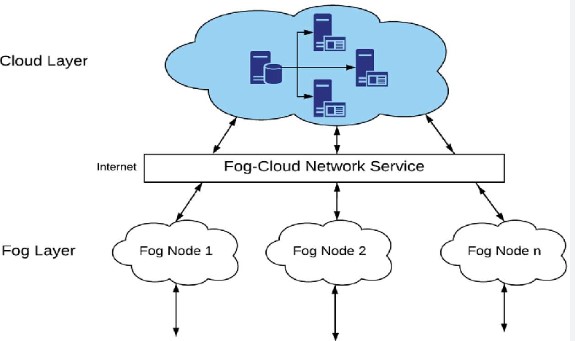
Understanding Fog Architecture: Fog architecture, also known as fog computing or edge fog architecture, extends the capabilities of cloud computing by distributing resources and services closer to the network edge. While cloud computing focuses on centralizing data processing and storage in remote data centers, fog architecture emphasizes bringing computational power, storage, and networking capabilities to the edge of the network, closer to the devices and users.
Key Components of Fog Architecture:
Edge Devices: Edge devices, such as smartphones, IoT devices, and sensors, form the foundation of fog architecture. These devices generate massive amounts of data and require immediate processing and response.
Fog Nodes/Gateways: Fog nodes, located at the edge of the network, act as intermediaries between edge devices and the cloud. They provide computational resources, storage, and networking capabilities, enabling real-time processing and data analysis.
Cloud Data Centers: Cloud data centers remain an integral part of fog architecture. They handle resource-intensive tasks, store massive amounts of data, and offer long-term storage and processing capabilities.
Benefits of Fog Architecture:
Low Latency and Real-time Responsiveness: By moving computing resources closer to the network edge, fog architecture reduces the latency between devices and cloud services. This allows for real-time data processing, enabling applications that require immediate response, such as autonomous vehicles, industrial automation, and augmented reality.
Bandwidth Optimization: Fog architecture minimizes the need to transfer large volumes of data to the cloud for processing. By performing data analysis and processing at the edge, only relevant and summarized information is sent to the cloud. This optimizes bandwidth usage, reduces network congestion, and lowers operational costs.
Improved Reliability: Fog architecture enhances the reliability of applications by reducing dependence on the cloud. With distributed computing resources at the edge, applications can continue to function even when connectivity to the cloud is disrupted. This is particularly critical in scenarios where reliable operation is crucial, such as healthcare, emergency services, and critical infrastructure.
Data Privacy and Security: Fog architecture enables data to be processed and analyzed closer to its source, minimizing the need for data transmission and storage in the cloud. This approach enhances data privacy, reduces the risk of data breaches, and ensures compliance with data protection regulations.
Scalability and Flexibility: Fog nodes can dynamically scale their resources based on demand, ensuring efficient resource allocation and optimal performance. Additionally, fog architecture enables the deployment of applications and services closer to users, allowing for localized customization and tailored experiences.
Applications of Fog Architecture: Fog architecture finds applications across various domains, including:
Smart Cities: Fog computing facilitates the implementation of smart city initiatives by enabling real-time data processing and analysis at the edge. It supports applications like traffic management, public safety, environmental monitoring, and energy management.
Industrial IoT: In industrial settings, fog architecture enables real-time monitoring, predictive maintenance, and process optimization. It enhances efficiency, reduces downtime, and supports autonomous decision-making at the edge of the network.
Healthcare: Fog computing enables remote patient monitoring, real-time health data analysis, and timely intervention in healthcare settings. It supports telemedicine, personalized patient care, and efficient healthcare delivery in remote or underserved areas.
Retail and Logistics: Fog architecture facilitates inventory management, supply chain optimization, and real-time tracking in retail and logistics sectors. It enhances customer experience, streamlines operations, and enables efficient resource allocation.
Conclusion:
Fog architecture extends the capabilities of cloud computing by bringing computational resources, storage, and networking closer to the network edge. By leveraging fog architecture, organizations can achieve low-latency processing, real-time responsiveness, enhanced data privacy, and improved reliability. With applications spanning smart cities, industrial IoT, healthcare, retail, and logistics, fog architecture emerges as a key enabler in the era of edge computing. As technology continues to evolve, fog architecture holds great promise in shaping the future of cloud computing by seamlessly integrating cloud services with the power of edge computing.


